All posts by 4thandcentral

UrbanABQ is the brainchild of Tim T. and Dan M., two dedicated urbanists from Albuquerque, NM. They have both traveled extensively, observing the good, the bad and the ugly sides of urban form and development. Together, with help from many community members, they are developing a vision for a stronger and better Albuquerque, an UrbanABQ.

The Necessity of Transforming Indian School Road

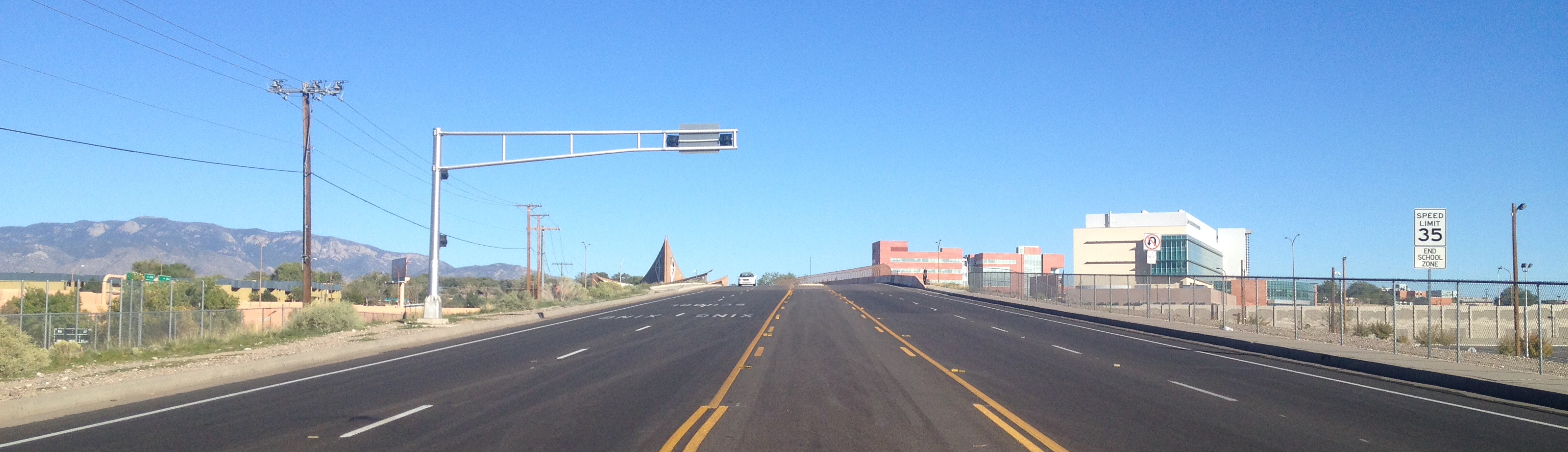
A typical view of Indian School: wide and empty

-Dan Majewski

Indian School Road is a typical Albuquerque road: wide and, for most of the day, empty.

In fact, Indian School is more empty than the typical overbuilt Albuquerque road.

Let’s take a look at the data.

Plenty of Space to Speed

According to the most recent MRCOG Traffic Count Data, Indian School between San Pedro and Broadway handles an average of 10,000 cars/day.  The most traffic heavy segment has 14,700 cars/day while the least trafficked segment receives a paltry 7,500 cars/day.   This is a five lane road + bike lanes + narrow sidewalks (only 3 feet in some places) / portions with no sidewalks.
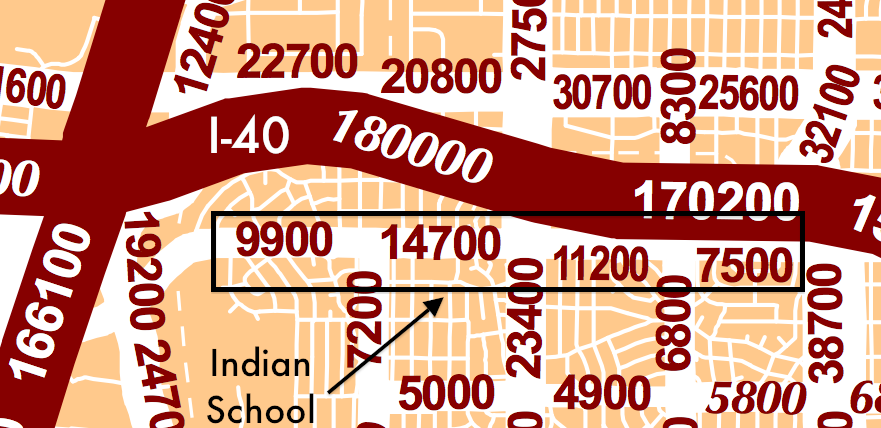
For my average, I included data not seen on this traffic count map segment.

To put that into perspective, San Pedro between Kathryn and Zuni (illustrated below), which currently has a single vehicle lane in each direction + center turn lane + bike lanes in each direction, currently handles 10,000 cars/day without any problem.
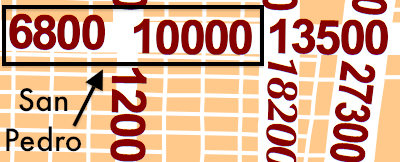
The black rectangle outlines the portion of San Pedro between Gibson and Zuni where there is a single traffic lane in each direction.

Zuni averages 18,000 cars/day and only one lane in each direction, which will soon be the case, will not be a problem.  Central Ave. between Downtown and Lomas handles 11,500 cars/day.  It recently received lane reductions and most of the day, it is still quite empty.  The main difference?  Bicycles now fill the new bike lanes where previously it was impossible to ride.

Why Should I Care?

Low traffic + many lanes = high speeds.

Just think about it.  You roll up to the red light.  You switch out of the left lane into the empty right lane, queueing up next to the car in the other lane.  You look at each other.  The light turns green; it’s a race!  You both accelerate, trying to get ahead of each other.

VS.

You pull up to the red light behind the car in front of you.  The light turns green.  You both proceed, one after the other, going the speed limit.

High speeds kill.  They kill people in cars, on foot and on bicycles.  They kill the possibility for active and vibrant street life.  They kill peoples desire to bike or walk, feeding a culture of fear, obesity and car dependancy.

We Already Have Bike Lanes and Sidewalks!  What Would We Do With an Extra Lane in Each Direction?
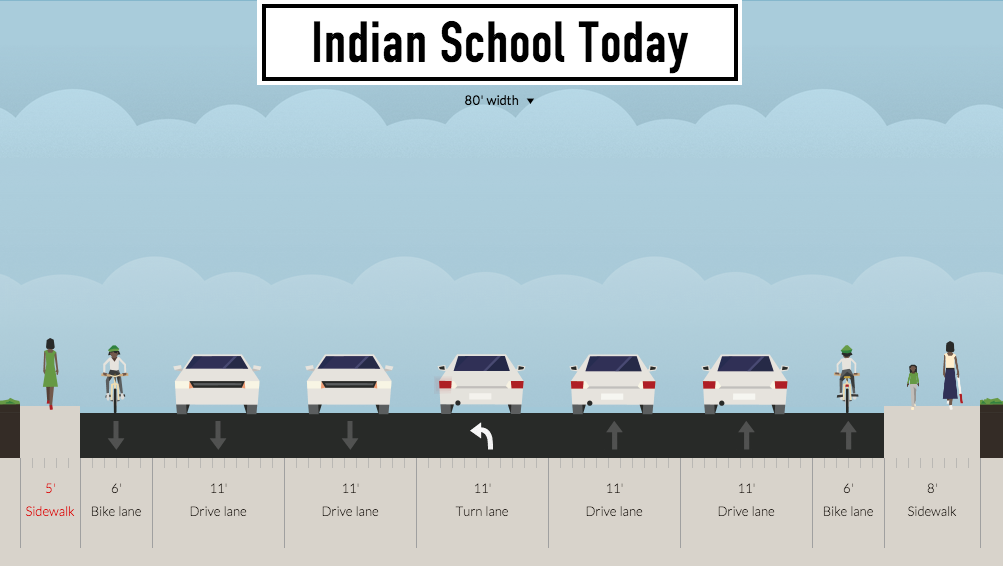
This is how most of Indian School looks today though some segments have even narrower sidewalks.

As of today, Indian School is technically a “complete street“.  It has a bus route…. which runs only 4 times per weekday.  It has bike lanes… narrow and right next to two lanes of fast moving traffic.  It has sidewalks… extremely narrow, disconnected and lacking shade or buffer from the fast moving traffic.

If a lane in each direction was removed, Indian School could become the premier road revamp in the country.

VISION

Imagine: wide, buffered cycletracks on each side of the street, painted bright green.  Wide, landscape buffered sidewalks.  A planted median and landscape buffered sidewalk filled with native plants and bioswales that drain the paved surfaces when it rains.  Multiple well marked mid-block crosswalks.  A safe, well lit, signage filled vibrant connection between:

  • Downtown
  • Albuquerque High School
  • University Blvd. (location of a proposed world class BRT line)
  • the North Diversion Channel Trail (extremely popular multi-use trail)
  • Girard (soon to be a premier complete street)
  • Whole Foods Grocery
  • Carlisle (and the popular #5 bus)
  • Washington St. (popular bicycle route)
  • San Mateo, a top city transit corridor
  • Uptown
  • and more!

The neighborhoods streets surrounding this segment of Indian School Rd. are already well used by bicycles due to proximity to the University.

Using Streetmix, an incredible online street visioning tool, I have designed the potential outcome of this project.

QUICK FIX
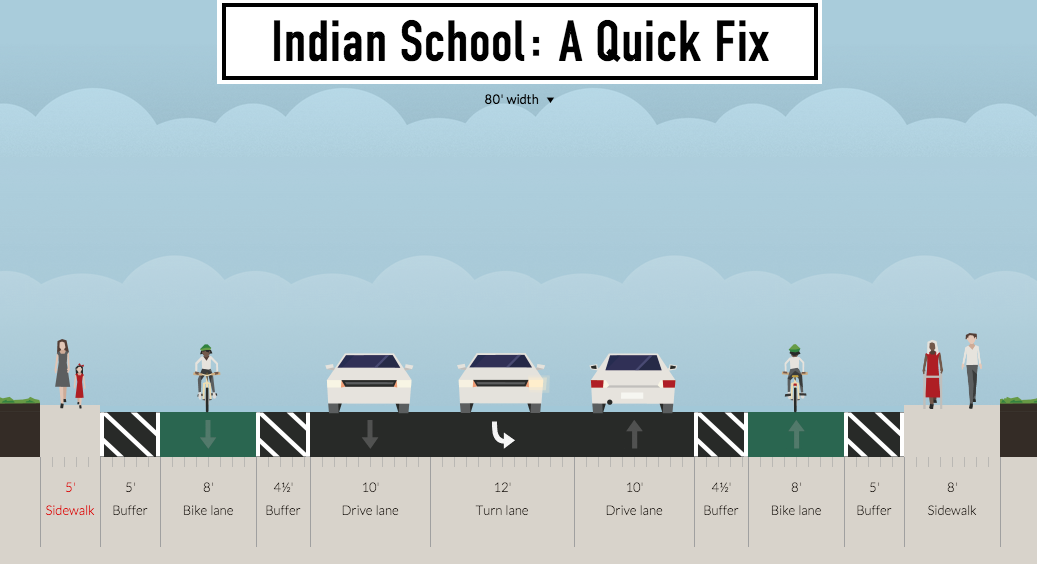
This could be done tomorrow with paint.

For just 1/169th of the cost of the Paseo del Norte project or $135,000 (Source: Wichita Planning Dept), tomorrow, the city could re-stripe the right lane in both directions, slowing down speeds and creating a wide, buffered cycling facility on this four mile stretch.  It would be a massive regional mobility improvement for cyclists and pedestrians.  The success of this “pilot project” could drive support for the more comprehensive rebuild of the road.

Below is a picture of 8th Avenue in New York City which recently received a similar treatment to the one proposed for this corridor.
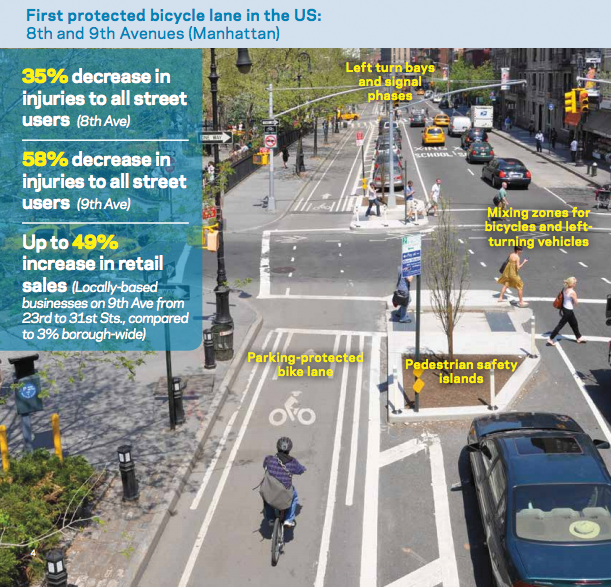
Click on the image to read about all of the positive impacts of the realignment of this street.

This will be a long expensive process but there are many strong arguments for transforming Indian School.  The strongest argument, in my option, is economic competitiveness.

THE IDEAL INDIAN SCHOOL

or

NATIONAL EXAMPLE = ECONOMIC COMPETITIVENESS
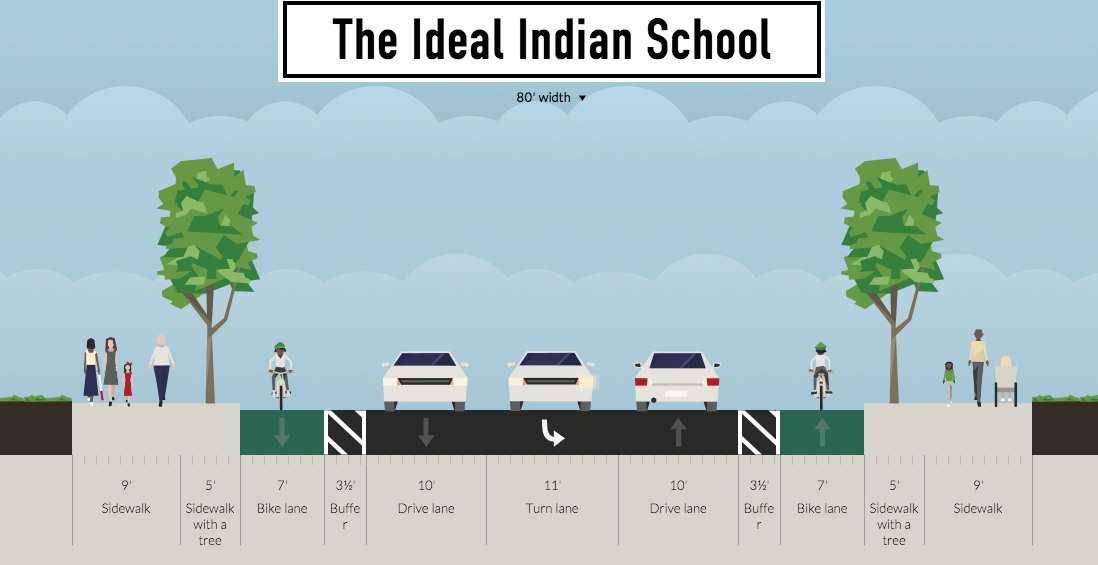
Beautiful isn't it?
Beautiful isn’t it?

Every local politician and city leader is obsessed with bringing more jobs to Albuquerque.  This is understandable; one could argue that the recession never ended in Albuquerque.  Another problem is the retention of young people.  Austin, Denver, Ft. Collins, Portland and other cities in the region are drawing young people away from Albuquerque.  They are growing, creating opportunities which do not exist here.  A major attraction of these urban areas is their vibrant urban cores.

What if the city decided tomorrow to do a massive revamp of Indian School?  If marketed correctly, the project would gain attention from national websites and news blogs such as Streetsblog and Atlantic Cities.  Branding Albuquerque as a national center of walkable progressive street design would be hugely beneficial to our economic standing.

Will a green painted buffered bike lane single-handedly save Albuquerque?  Absolutely not.  However, there is growing evidence that young people and old people and even middle aged people are suddenly more interested in living in communities where walking and cycling are normal, comfortable and rational.

The Indian School corridor is already so close to being one of these complete communities.  It is surrounded by bikeable and walkable neighborhoods, transit corridors and unique small businesses.

The cost to do this project is priceless.  We can not, as a community, afford to continue to let motor vehicles rule our roads.

Why not finish it right?  It can only help our community which so desperately could use it.
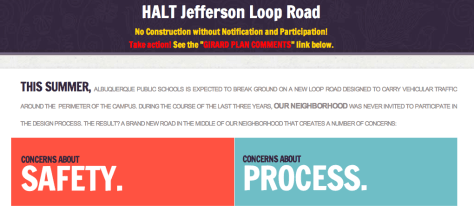
Jeff Speck + Jefferson Middle School: Improving a Problematic Proposal

– Dan Majewski

Click this image to visit HaltTheLoop.com

NOTE: Jefferson Middle School may soon fall to the bulldozers and a loop road will be constructed around the school. This proposal has been pushed through without any public process. If you have an interest in learning more about this issue or preventing it from happening, click the image above to visit HaltTheLoop.com.

On the evening of August 14, the renowned urbanist and author Jeff Speck lectured at the Hotel Parq Central. The attendees were a diverse mix of community members including city planners, developers and other interested citizens. Mr. Speck’s ability to speak candidly about the issues facing Americas urban communities was refreshing and helpful. His new book, Walkable City, outlines in detail many of the themes highlighted in his presentation. If you are interested in making Albuquerque or any city more economically sustainable and physically healthier, I strongly recommend this book. It is light on the jargon yet it clearly highlights the ingredients necessary to create cities for people.

Mr. Speck Goes to Jefferson
The next morning, I joined Jeff Speck and a couple of other community members on a tour of Jefferson Middle School. The discussion topic was a proposed loop road around the perimeter of the school. I previously wrote an article about this issue titled Why Don’t Children Walk to School Anymore? Crisis and Opportunity at Jefferson Middle School.

We arrived at the school around 8:10 AM during the peak of the morning parent drop-off rush. It was relatively tame on Girard: slow speeds, minor congestion and relatively fluid movement. Once we entered the adjacent neighborhood, the issues became more visible with high volumes of parent drop-off traffic observed. This created potentially dangerous situations for the many students and residents walking or biking on these streets.

We parked and entered the school grounds from one of the three walking paths which connect the neighborhood to the school. The loop road plan was briefly explained to Jeff and as we walked he began to draw.

Mr. Speck observed that there was very little traffic on Lomas considering it was the peak of morning rush hour. Sure enough, the traffic counts show that this segment of Lomas is overcapacity and does not need three lanes in each direction.

Lomas could easily lose a lane between Carlisle and Girard

For comparison in the image above, observe that Central, highlighted on the bottom of the image with a black rectangle, handles almost twice the amount of traffic (31,200 cars/day) between Girard and University with only two lanes in each direction. I encourage you to play with the large full version of the traffic count map in the image above: 2011 Traffic Flows for the Greater Albuquerque Area.

In just 45 minutes, Mr. Speck quickly sketched out three alternatives to the loop road which were far superior to anything presented by APS. They are as follows, beginning with least expensive/physically easy and ending with most expensive/physically difficult:

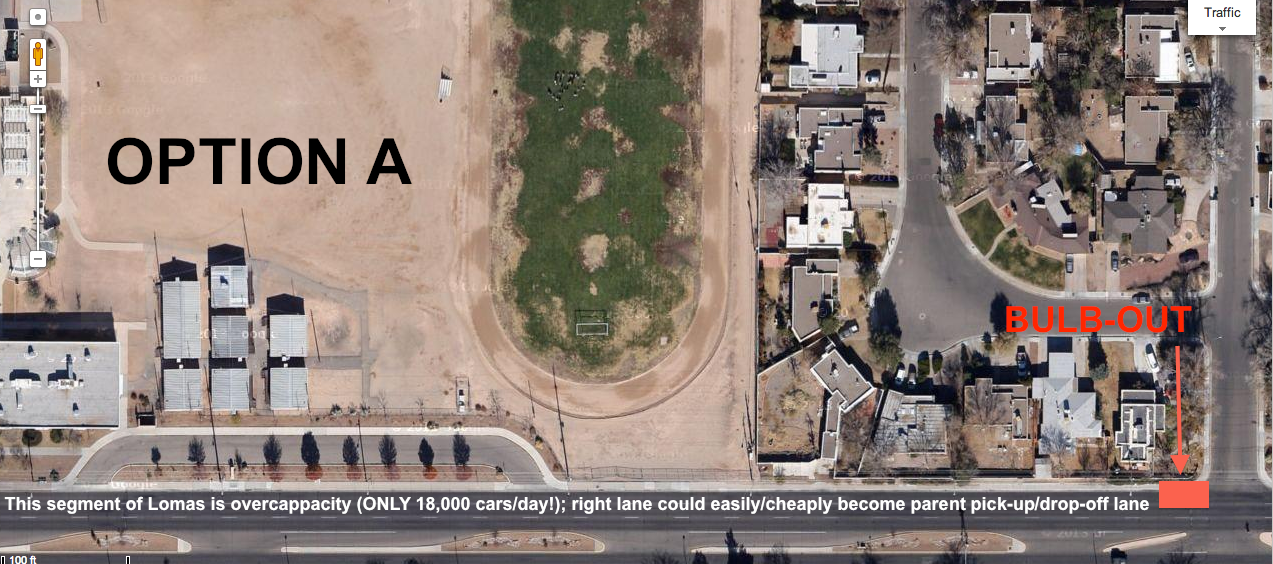
Click to enlarge!  This image illustrates the conversion of the existing right lane into a pick-up / drop-off lane
Click to enlarge! This image illustrates conversion of right lane into a pick-up / drop-off lane

OPTION A: Blub-Out on Lomas = Traffic Calming, Lower Speeds
This plan would be both incredibly cheap and physically easy to implement. Regarding physical infrastructure, it would only require a bulb-out (COST: ~$20,000; source) and pavement markings instructing vehicles where to stack, where to turn, etc. Compare this to the cost of the proposed loop road at $572,000. The graphic above explains Option A in detail. As written in the graphic, this segment of Lomas only averages 17,400 cars/day! This volume of traffic could easily be managed with only two lanes vs. the existing three lanes.

A major side benefit of this plan would be reduced speeds and traffic calming. One less traffic lane would give vehicles one less opportunity to pass aggressively, making it safer and easier for people to cross the street.

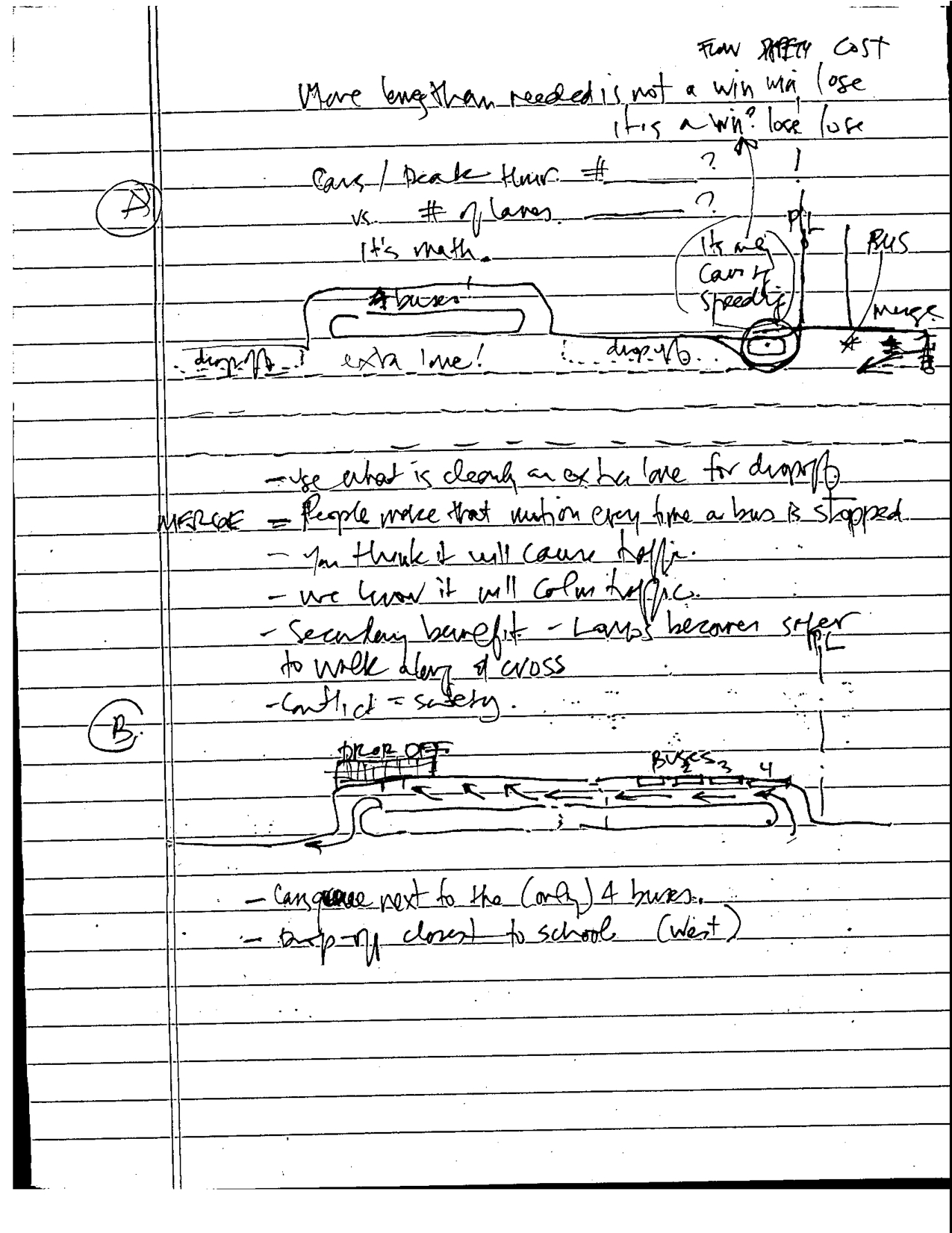
Click to enlarge!  Speck's sketch of Options A and B
Click to enlarge! The J. Speck sketch of Options A and B
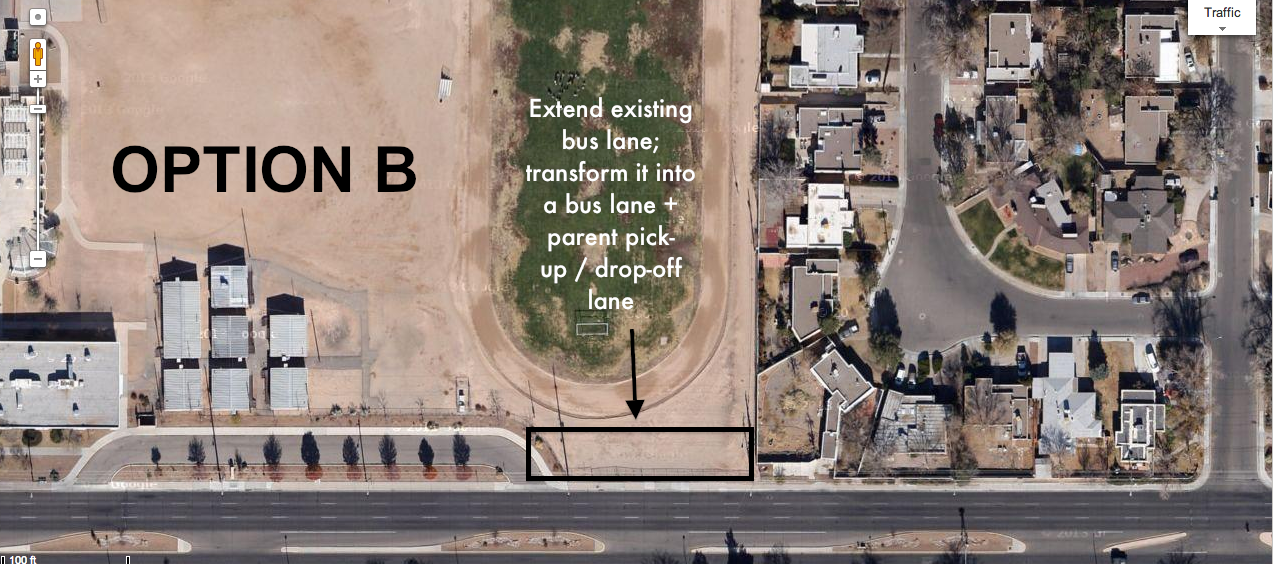
Click to enlarge!  This image shows the space available to enlarge the existing bus drop off area
Click to enlarge! This image shows the space available to enlarge the existing bus drop off area

OPTION B: Extended Bus Drop-off Lane
According to neighborhood residents, Lomas is only serviced by four school buses. However, the bus lane is wide and if extended, could easily handle the existing four buses as well as a significant percentage of the parent pick-up/drop-off traffic. The graphic above explains this alternative in more detail. Since this option would involve extending something that already exists, the cost to build it would be much lower than the proposed loop road.

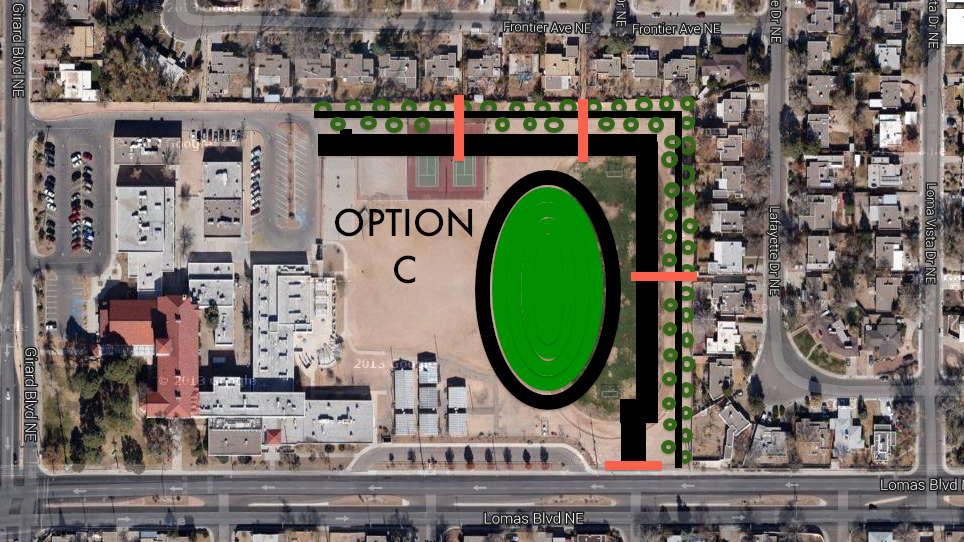
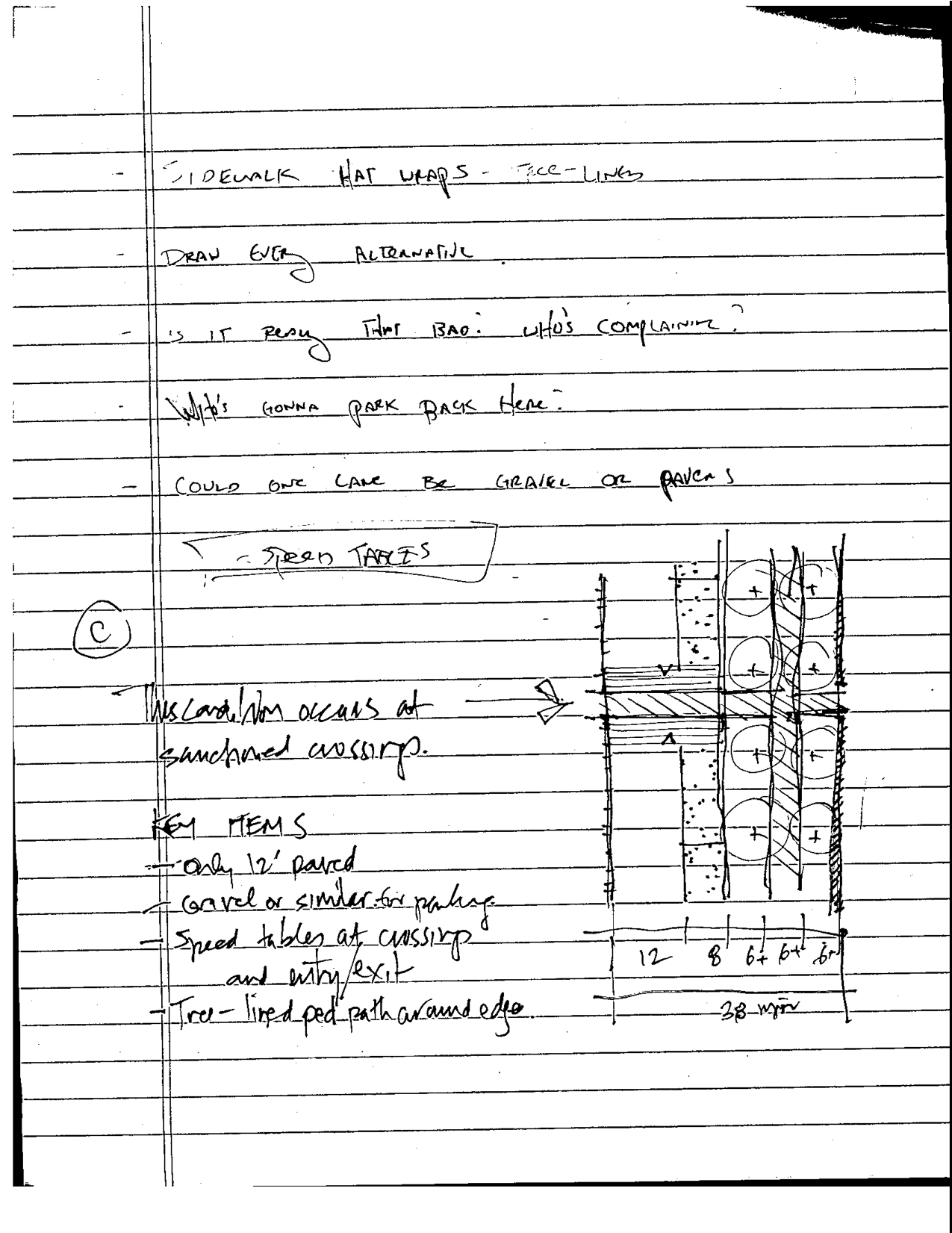
Click to enlarge!  In my rough illustration, the red rectangles represent the enhanced crossings proposed by Jeff Speck.  A tree lined sidewalk skirts the outer edge of the project area
Click to enlarge! In my rough illustration, the red rectangles represent the enhanced crossings proposed by Jeff Speck. A tree lined sidewalk skirts the outer edge of the project area

OPTION C: Tree Buffered Loop Road + Enhanced Crossings + Narrowed Pavement
This option, pictured above, would require the least amount of deviation to the existing plan. However, the enhancements discussed here would lead to a much higher quality project.

The image below was drawn by Mr. Speck. In his drawing, the proposed 24 ft. road has been transformed. Mr. Speck proposed:

12 ft driving lane +
8 ft. gravel parking lane +
6 ft. tree buffer +
6 ft. sidewalk +
6 ft. tree buffer

Click to enlarge!  The right side of this image, drawn by Speck, details proposed new alignment
Click to enlarge! The right side of this sketch by Speck details the proposed new alignment

A 12 ft. driving lane plus an 8 ft. parking lane vs. the proposed 24 feet of pavement would mean lower speeds plus less storm water drainage issues.

The tree lined sidewalk would both reduce the heat island effect of the new road and provide a pleasant walking environment for the significant percentage of students who walk to school.

Another critical element of the Speck plan is raised crosswalks at all three of the neighborhood pedestrian cut throughs plus the two ends of the road. Below is an illustration of a raised crosswalk:

A hybrid crosswalk and speed table, raised crosswalks are a great way to slow down traffic and provide safe crossings

Creating Places for People
Jeff Speck saw the issues at Jefferson Middle School and quickly found cheap, easy and reasonable solutions to the current problem. Regarding Option A, Jeff Speck made this point:

If we think in isolated boxes, we are fixing a school drop off problem by creating a traffic problem. If we think synthetically, we are fixing two problems at once: school drop off and an unsafe sidewalk against speeding traffic.

This project is interesting because of the larger context. APS is one of the most influential organizations in the City of Albuquerque. If they do not have an interest in encouraging walkable environments around their schools, the whole city loses. Regarding walkability, schools and children are the lowest hanging fruit. By design, most student live in close proximity to their school, especially if it is a middle school or an elementary school. Encouraging walkability is simply good economics: parking lots and loop roads are a lot more expensive than crosswalks and bike lanes.

Jefferson Middle School has a history of students walking and biking to school. Though a significant percentage of students are now attending from outside the district, there is still plenty of opportunity to encourage walking and biking.

Since APS does not have to answer to any higher authority, they are acting in a disrespectful manner. They refuse to acknowledge all of the better options that could be used to solve the parent drop-off/pick-up problem. They want the project to be completed and for the neighbors to get out of the way.

The city has not yet granted the curb cut that Jefferson/APS needs in order to complete the road but the writing is on the wall. Within the past couple days, fences and other infrastructure have been placed, suggesting an imminent start to this project.

It is unfortunate that APS does not want to build a good relationship with its neighbors. It is a missed opportunity and it will leave behind bad blood in the neighborhood for years to come.

TAKE ACTION!
Come to the Albuquerque City Council meeting tonight (August 19) at 5 PM and speak up for progressive walkable urbanism in Albuquerque!

Six Steps Towards a Better Burque for Bike Enthusiasts

– Dan Majewski
NOTE: This article was published in the Local IQ Magazine on July 30, 2013. The link to the article on their website can be found here: Six steps toward a better Burque for bike enthusiasts. Please visit their website and pick up the print edition. This months issue is chock full of bicycle related articles as well as the usual cultural fare. Support them! The article below is exactly the same except for a couple of hyperlinks and a graphic. Enjoy!

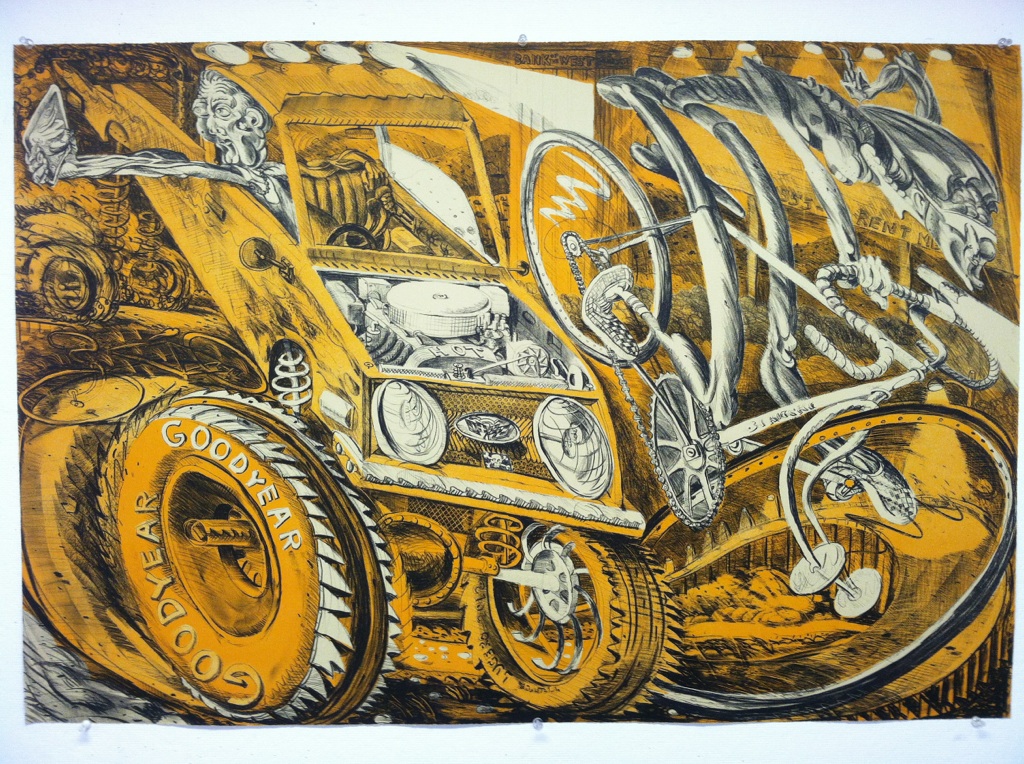
Graphic interpretation of cycling on city streets in ABQ by local artist Trevor Lucero

Albuquerque has historically performed well in the game of “top American cycling cities.” Our multi-use path network is the envy of municipalities across the nation: 50-plus miles of paved path, completely separated from automobiles. Add other lanes and routes to the total and we have 400-plus miles of bicycle infrastructure! City leaders have worked hard to accomplish this and they should be commended.
However, the development of cycling infrastructure in Albuquerque is stagnating. This may come as a surprise to many residents. After all, new paths open annually and visible improvements to our network are constantly being made, though many major American cities are evolving at a more rapid pace than the Duke City. The key to keeping up? Get more people riding. Below is a list of six ideas for how the City of Albuquerque can do that:
1. Fill The Gaps
Cycling in Albuquerque is 90 percent heaven and 10 percent hell. The weakness of the city’s existing network is found in the gaps between the paths, lanes and routes. Some of these dangerous gaps have been the site of fatal cycling collisions. Many of them exist near interstate on/off ramps.
Properly filling these gaps would be expensive and could require taking away space from motor vehicles, which is never easy politically. Yet, until the city understands the vital importance of utility cycling (using bicycles for transportation), Albuquerque will stagnate. Filling these dangerous gaps must be a primary focus.
2. Connect the Dots 
Our bicycle path network is a great idea: build facilities that are separated from vehicles. This prevents any possibility of conflict between motorists and cyclists, creating a safe, quiet and relaxing environment. However, to access the paths, one must ride on streets that do not accommodate cyclists.
The trails do not directly connect with any place that one needs to go: the grocery store, the bike shop, etc. Businesses can be accessed from the trail but there is no relationship between the destination and the trail. The trails have been designed specifically for recreation. Besides the Bosque Trail, they are not pleasant public spaces. Citizens are currently leading a movement called BIZ (Bike-in Zoning) that would allow small businesses to open up along the trail, activating the space. Connecting the existing network to popular destinations is vital.
3. Don’t Forget About the Bus
To be a top cycling city, we need to be a good walking and transit city. New York is quickly transitioning to a bicycle-friendly place because many people do not own cars. A quality cycling city cannot be dependent on cars. It is no accident that Albuquerque’s Central Avenue corridor has a high percentage of people cycling for transportation. Filling the gaps in our transit and sidewalk network is crucial. To make this a reality, citizens must push government officials to take the difficult steps required for this transformation.
4. Capture Low Hanging Fruit
The UNM area and Downtown are already filled with residents who do not own cars and primarily cycle or walk. Making these areas more bike-friendly first would be the best value. Other cities are building protected bicycle infrastructure in their downtowns or their universities. This is a natural next step for Albuquerque.
Bicycle boulevards like Silver Avenue are relatively quick and cheap to build. Creating a network of these around UNM would lead to an increased rate of cycling.
Many of our streets are over capacity. This means that they have more vehicle lanes than necessary to accommodate the amount of traffic. Re-striping certain streets in Albuquerque could happen tomorrow for minimal cost. It has already been done on some streets; there is no reason to stop now.
5. Education and Encouragement

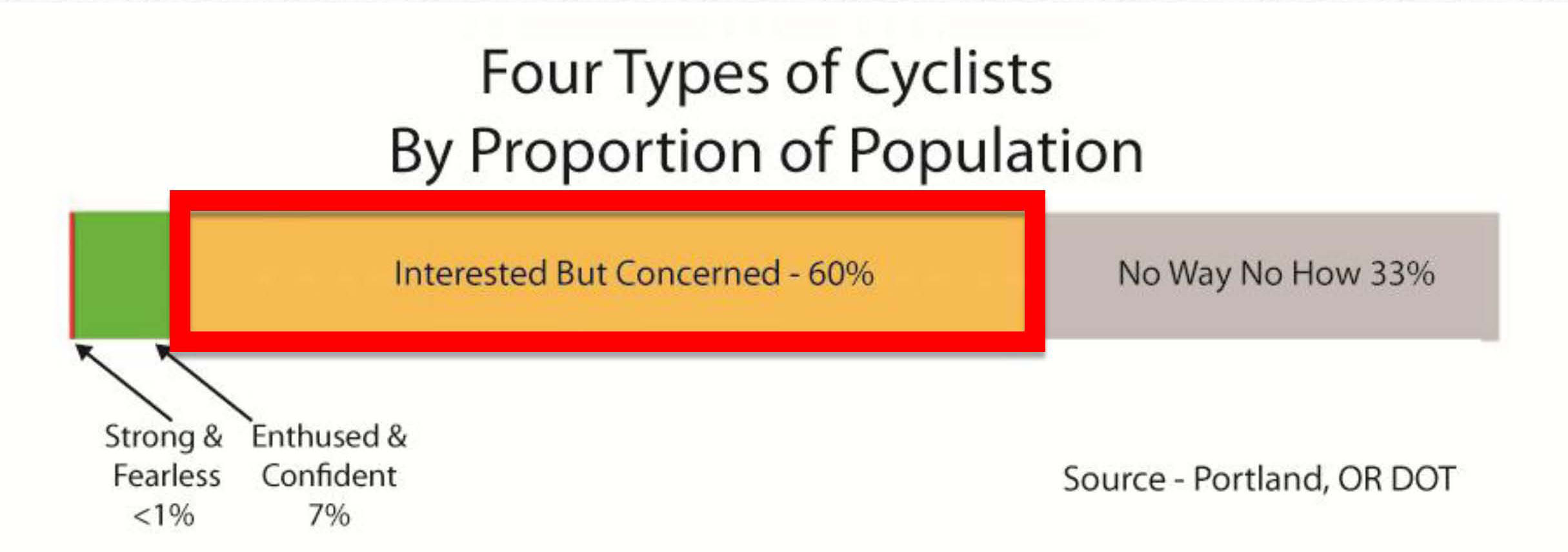
This graphic is the result of a study done at Portland State University

A recent study done in Portland, Ore. found that 60 percent of the population there is “interested yet concerned” about cycling for a number of reasons, primarily safety. The results of the study are displayed in the image above.
Converting “interested but concerned” residents into bicycle riders requires a massive amount of education and encouragement. Well-advertised and frequently scheduled classes that educate people how to safely ride in the streets is essential to the growth of bicycles as a mode of transportation. This is already being done. However, to increase the number of people cycling, this must be more integrated.
6. Strengthen Staff Numbers
The City of Albuquerque has one bicycle coordinator. They do not have a single pedestrian coordinator. And we wonder why our city looks the way it does…
To accomplish anything from this article, there must be an increase in staff dedicated to making our city more people friendly. Adding a single staff person dedicated to cycling in our city would double the amount of work we could accomplish annually.
Conclusion
Albuquerque is on the cusp of a cultural transition. Hundreds of residential units are being developed downtown, microbreweries and food trucks are appearing everywhere and the awareness and importance of building community around active transportation and small local businesses is growing. Central Avenue is our spine and there are active community conversations occurring about the future of it. Bus rapid transit? Bike lanes?
We need a cohesive direction. A bicycle-friendly city is part of a larger vision. It includes more density, better transit and other elements that some long-time residents are uncomfortable with. Engaging the community is an important next step.
It is time for us to retake the lead. It will not be easy but it is our best opportunity to rebuild our broken economy. Building a more bike-friendly Albuquerque will not be difficult. Finding the funding and political support will be.

Follow urbanabq.com for more information on how to get involved.

Albuquerque’s Third Places: Michael Thomas Coffee

– Amos Stoltzfus

Mr. Stoltzfus is a guest contributor to Urban ABQ. More information about him can be found at the bottom of this post. Would you like to contribute to UrbanABQ.com? Email us at dan.j.majewski@gmail.com.

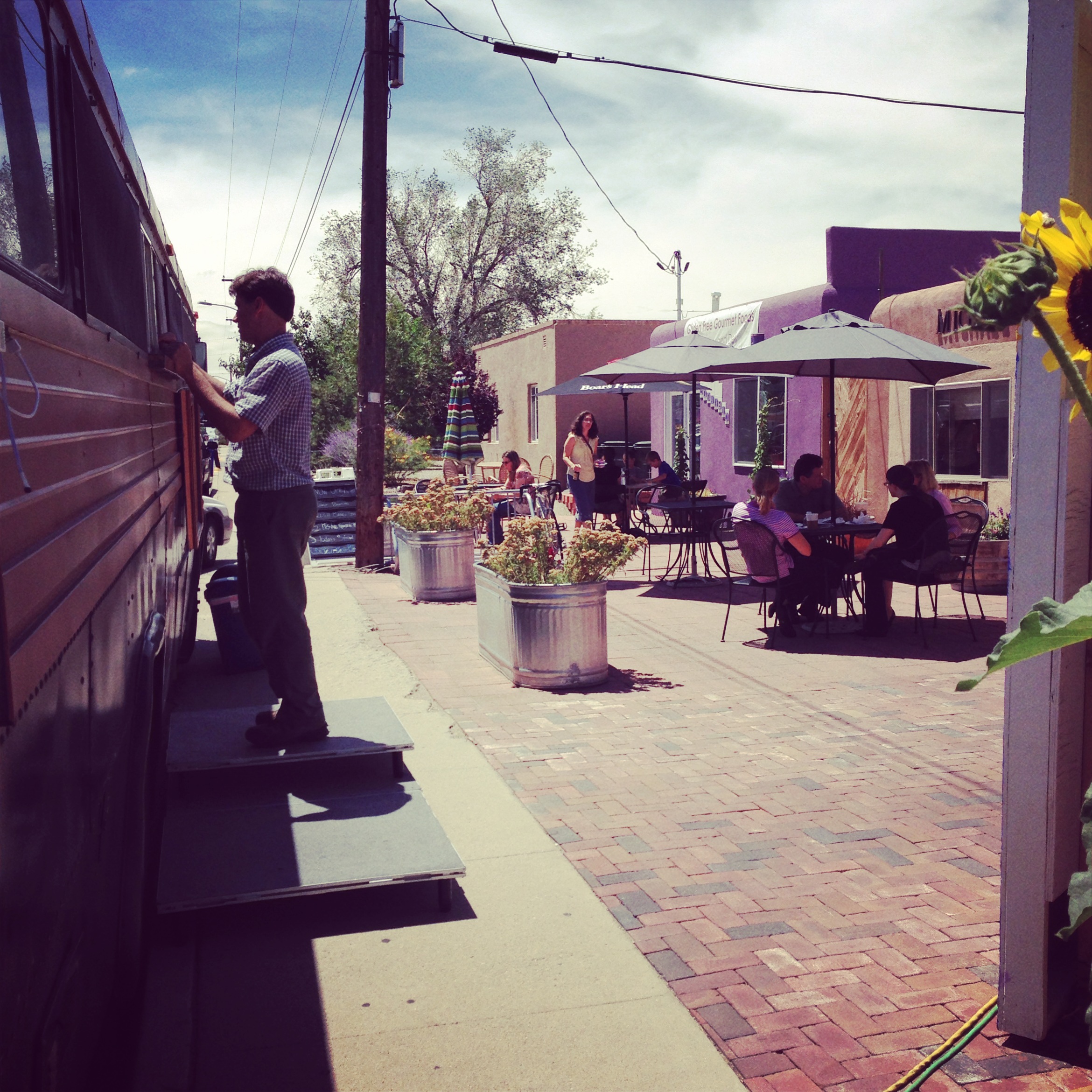
Michael Thomas Coffee now has a new neighbor: a gluten free bakery!

The term “third place” describes social spaces outside of the home and work that build a sense of community.

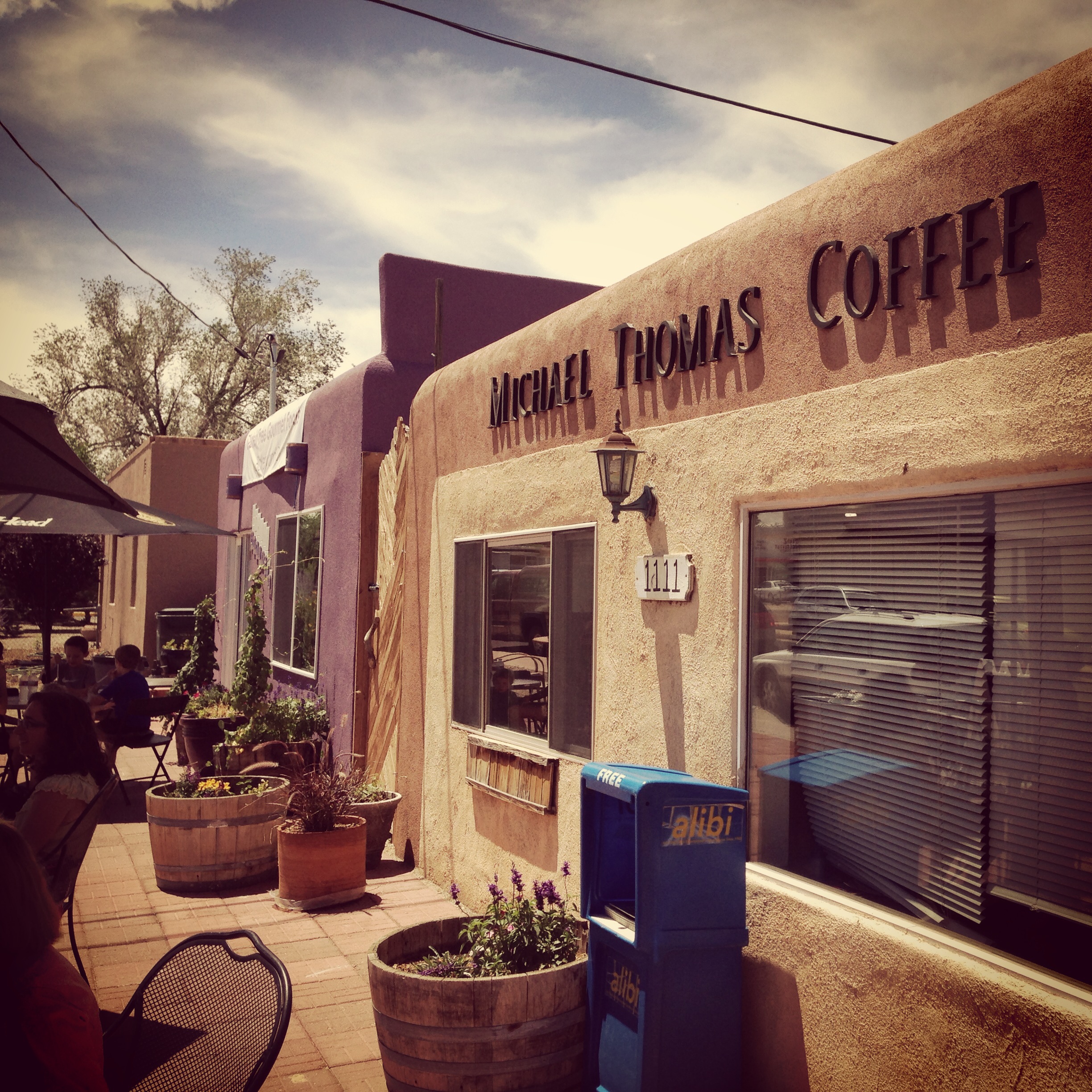
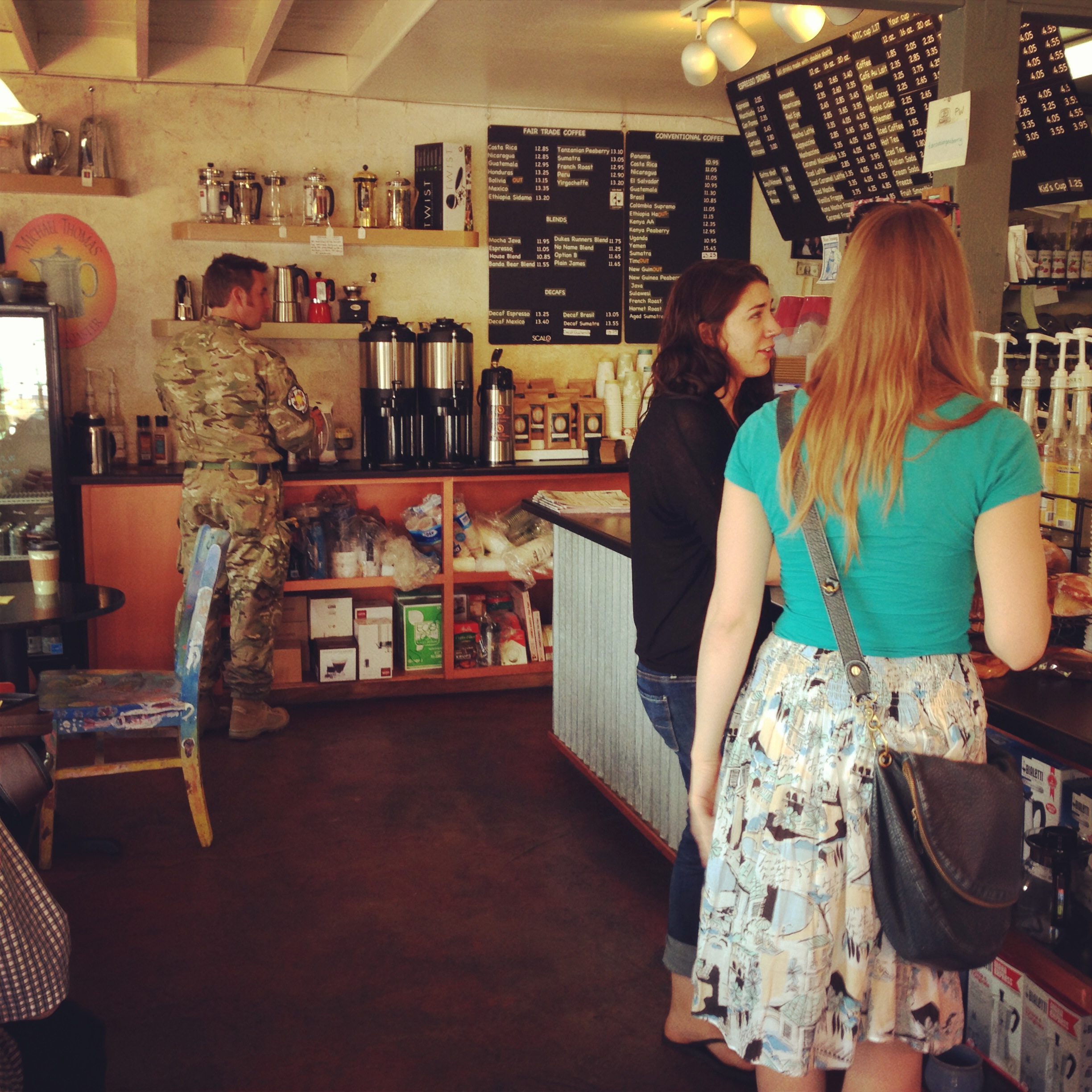
Walk into Michael Thomas Coffee – a small, family-run coffee shop and independent roaster located at 1111 Carlisle Blvd. in Southeast Albuquerque – and you are likely to be greeted within a few seconds. If you’ve been there before, the staff will probably remember your name.

The cozy interior of the coffee shop

When I want to catch up with my neighbors or find out if anyone has seen my dog (who has penchant for running away), I head to the coffee shop. It is the place to go when you are tired of being alone or you are tired of being tired.

When regulars talk about Michael Thomas, you will notice their tendency to use personal pronouns: This is my coffee shop. This is my place. But the physical space of the coffee shop forces us to share. Michael Thomas is cozy. And by cozy, I mean tiny. This is intentional. Hanging out at the coffee shop means that you’ll have to interact with people. Some of them may smell bad. That is part of the fun. It is this interaction that makes Michael Thomas such a special place. You come for the coffee, but you stay for the people.

Owner Michael Sweeney estimates that 75% of his revenue comes from the neighborhood. The price of a coffee is intentionally reasonable so that everyone in the neighborhood can afford a cup. If not, they will probably serve you anyway (you didn’t hear that from me).

Vibrant third places, such as Michael Thomas, are highly accessible to all, both geographically and financially. They promote social interaction, welcoming the usual suspects and newcomers. There is a feeling of comfort and belonging. My sense is that this is a rarity in Albuquerque. Like many cities, Albuquerque long ago separated residential and commercial uses. You can drive for miles through the neighborhoods on the West Side without seeing a local business. And if there is a potential third place nearby, there’s a good chance you will have to traverse a six-lane road to get there.

For many of us in Albuquerque who spend way too much time isolated in our cars and subdivisions and not enough time interacting with what makes all of us human, Michael Thomas Coffee reminds us that our lives are intricately connected to our neighbors, that we are never alone, and that a little love is only a cup of coffee away.

The addition of food trucks makes Michael Coffee even more awesome.

Amos Stoltzfus is a recent graduate of the Community & Regional Planning Master’s program at the University of New Mexico. He is currently employed as planning fellow with Granicus, a software development company dedicated to increasing government transparency and citizen participation. When he is not geeking out about urban planning, Amos can usually be found loitering at Michael Thomas Coffee or exploring Albuquerque on his bike.

CicLAvia and the New Los Angeles: Lessons for ABQ from the City of Angeles

– Dan Majewski

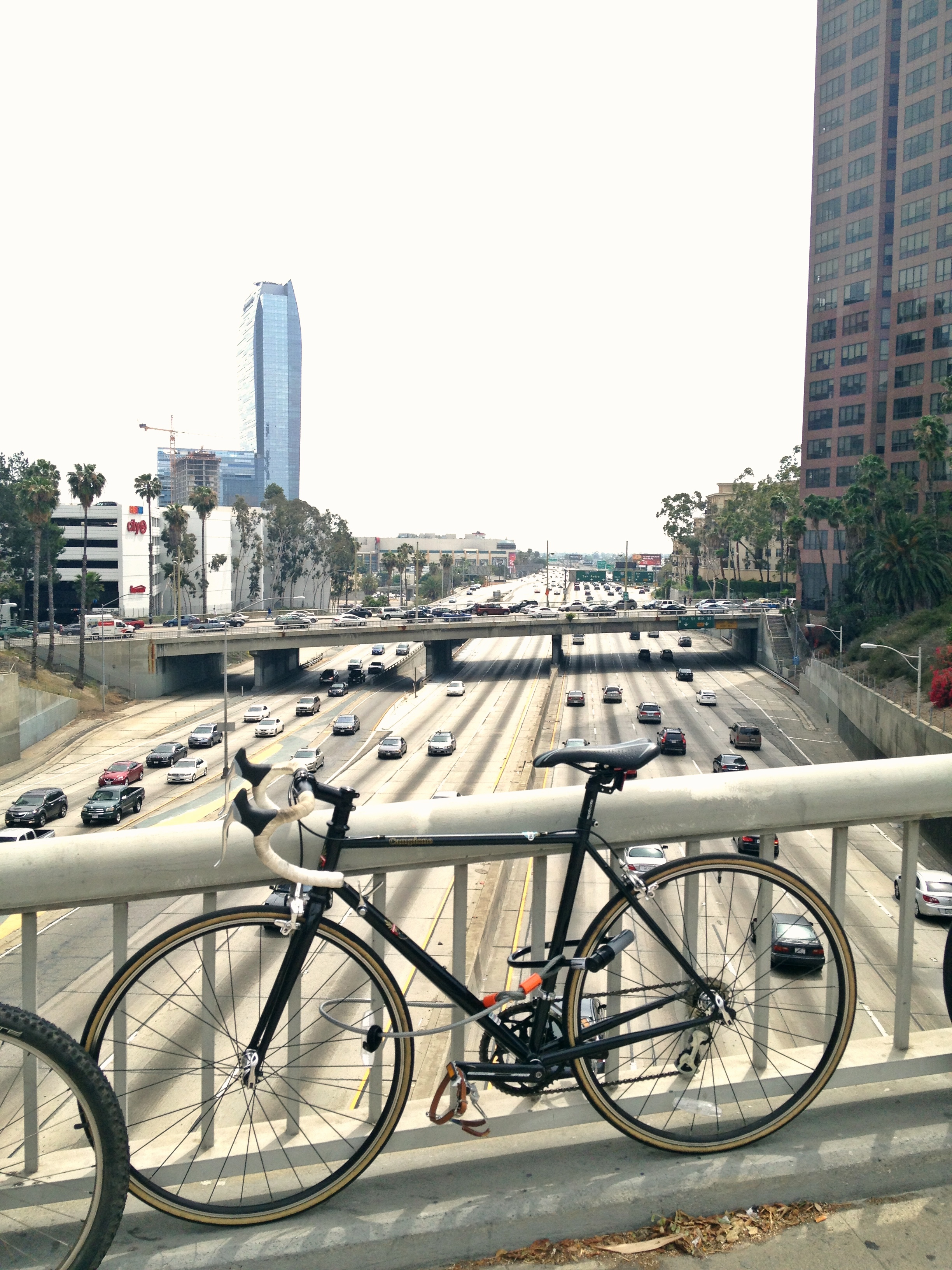
Overlooking the 110 Freeway, Wilshire Boulevard

IMAGINE: Central Avenue, from the Rio Grande River to San Mateo, completely closed for an entire Saturday or Sunday.  Open lots filled with stages and music.  More bicycles, rollerblades, long boards and strollers than you’ve ever seen in your life.  People lying in the middle of the street on a mattress.  Tall bike riding leotard-wearing youth.  Old Route 66 transformed into New Route 66, a street for people.

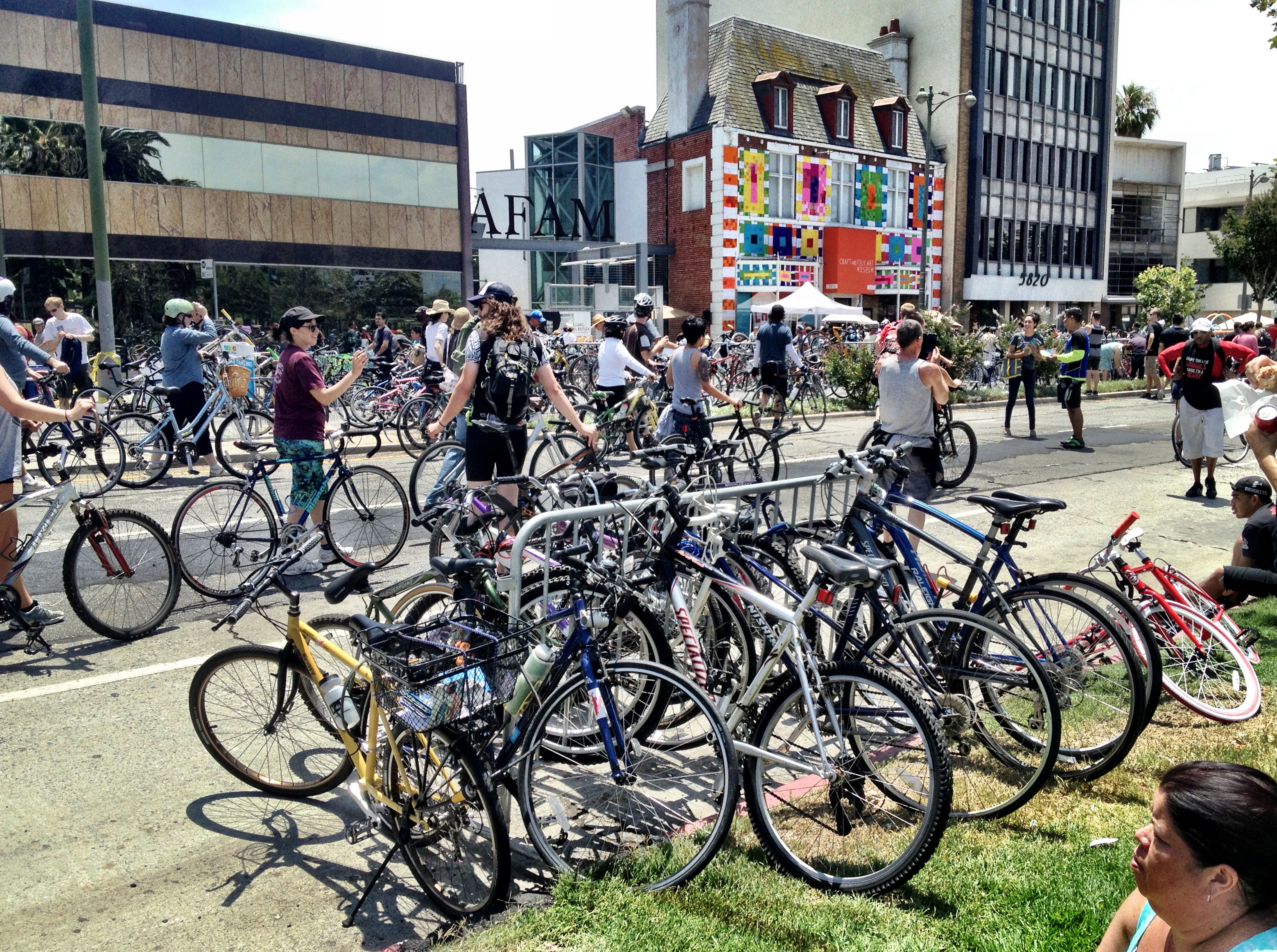
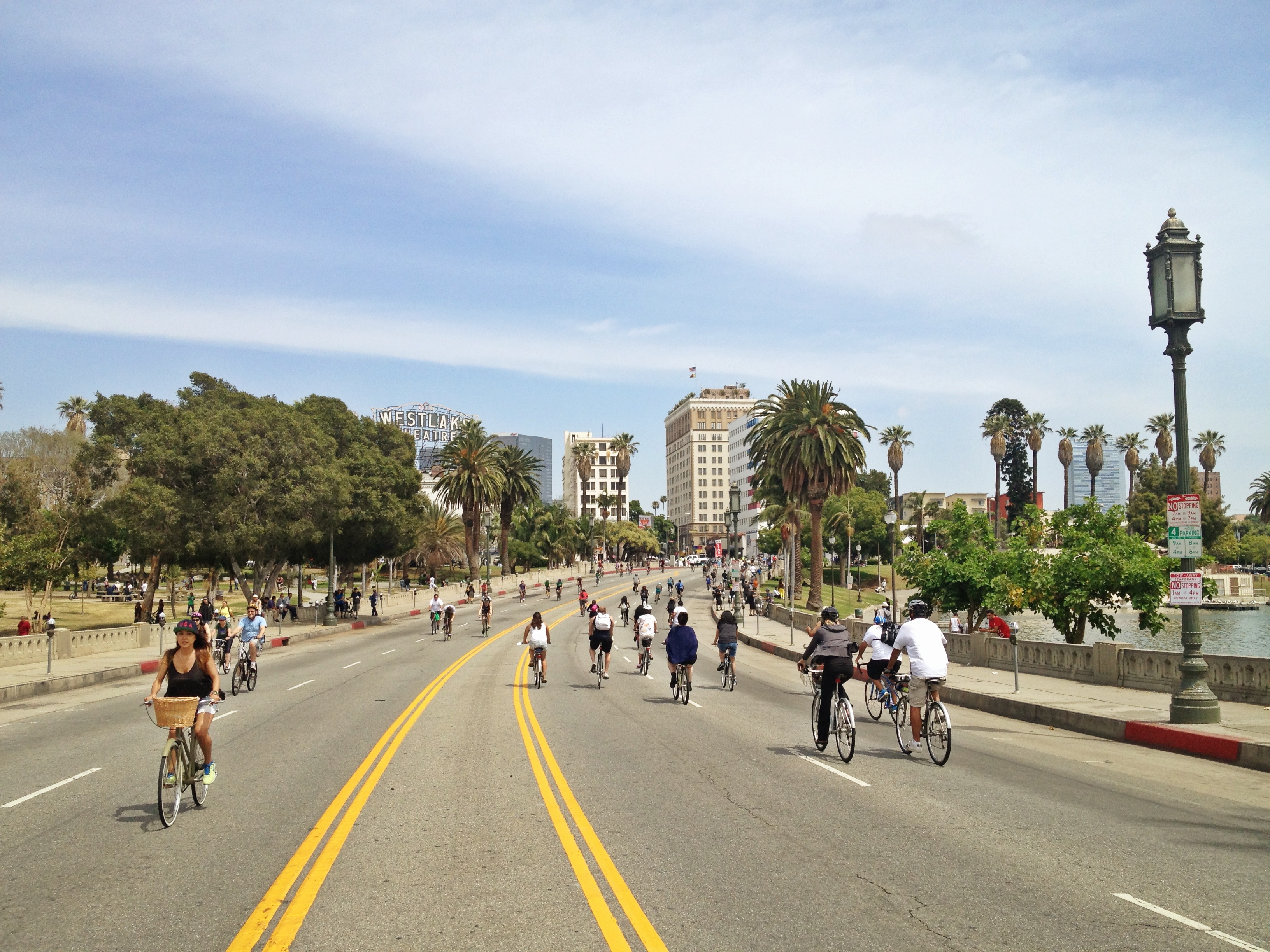
Try to count the bikes!

The equivalent of this happened in Los Angeles on Sunday, June 23.  Six miles of Iconic Wilshire Boulevard, the traffic and exhaust choked historic Main Street of Los Angeles, was closed to motor vehicles from 9 AM – 4 PM.

Streets filled with people, Downtown Los Angeles

What is CicLAvia?

The concept is simple:

1)    close the street to vehicles

2)    bring in food trucks, live music, yoga teachers, etc.

3)    make sure all of the businesses along the route are open

4)    see what happens!

It is based on ciclovia, a tradition that began in Bogota, Columbia three decades ago.  The concept is now rapidly spreading across the United States and other parts of the world.  Tucson, a city with many similarities to Albuquerque, is now planning its sixth event.  An estimated 25,000 people attended the most recent event in April.  Read about my experience at the first Tucson ciclovia here.

Los Angeles first tried this experiment on 10/10/10.  The route utilized side streets that normally had little car traffic.  It had public support but many a naysayer.  After all, modern Los Angeles is practically defined by car culture.  Los Angeles is world renowned for soul-crushing traffic jams, a massive freeway system, fancy celebrity filled Ferraris, Jay Leno’s car collection… you get the idea.

Despite the doubt, the inaugural CicLAvia was a huge success100,000 people huge.

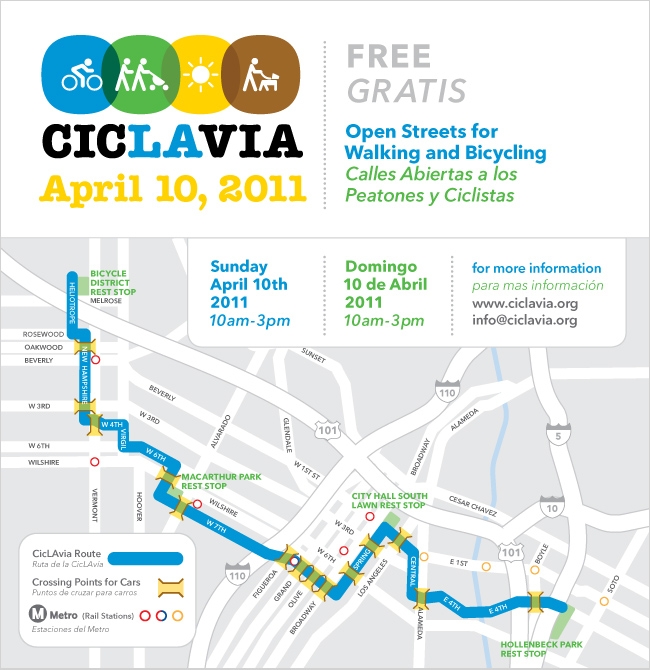
Map of the first CicLAvia event

Where is CicLAvia Now?

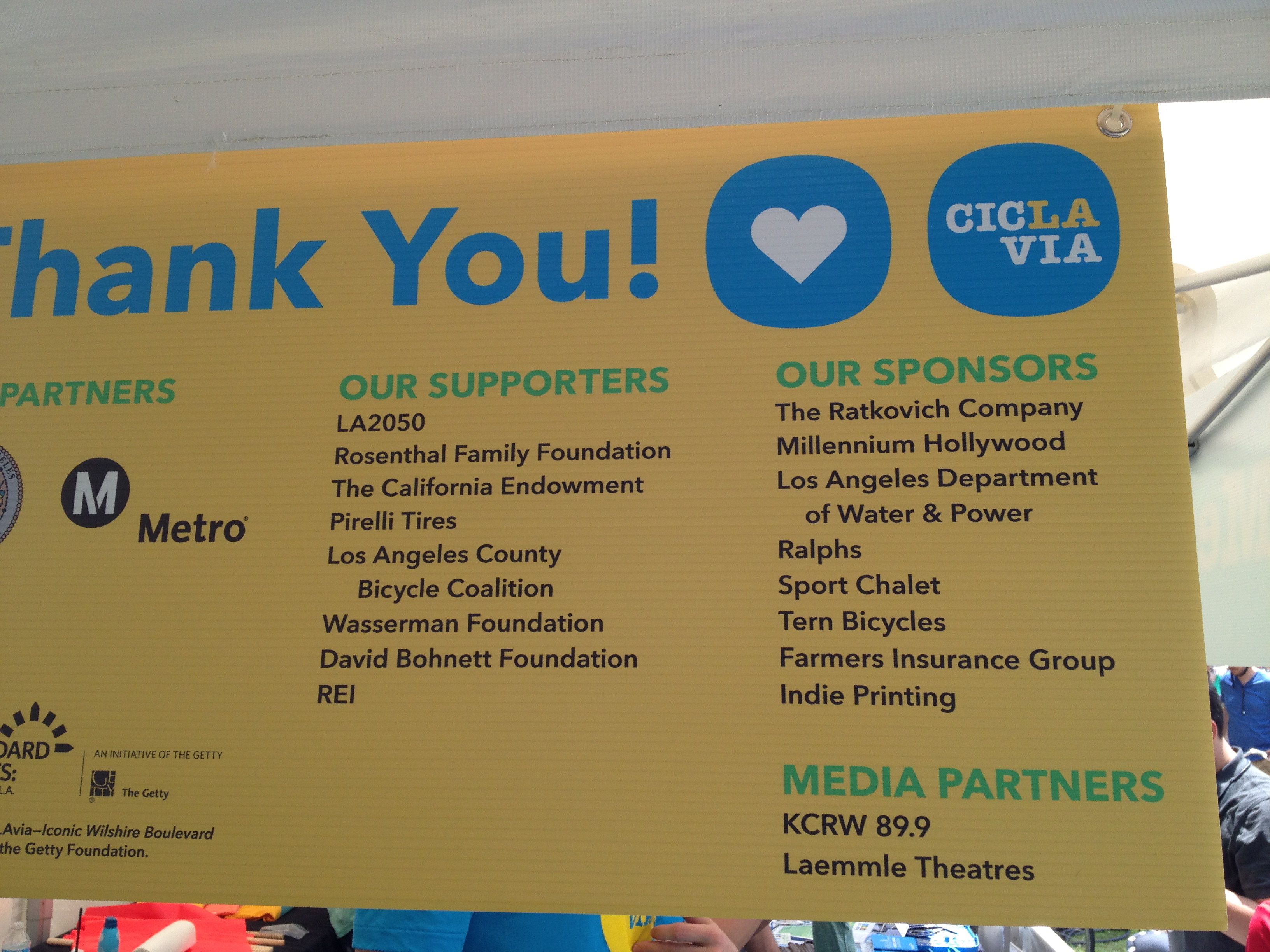
There will be three CicLAvia events on the streets of Los Angeles in 2013.  It has a vast array of financial supporters and local champions as shown in the photo below.

Banner displaying a portion of the major contributors to the most recent CicLAvia event

The event on June 23 was incredible.  The route itself included many famous buildings, museums and public spaces best seen at the speed of a bicycle or slower.  For the first time “dismount zones”, where people on foot were prioritized, anchored each end of the route.  It marked a welcome change in policy since the goal of CicLAvia is to open the streets to ALL non-auto users, especially people on foot.  The fact that this route was shorter than previous routes also made it easier to walk the entire distance.

Read more about the event here and here.  The official CicLAvia website can be accessed here.

Los Angeles, 2013
Los Angeles, 2013

The New Los Angeles

As someone who was born in Los Angeles and visits frequently, there is change afoot.  The Southland is truly beginning to shift its policy and funding priorities towards transit, cycling and walking.

Los Angeles, up until 5 years ago, barely had a bicycle plan.  It had little official acknowledgement of bicycles as either a form of transportation or a way to get some exercise and fresh air.  The big shift occurred when the outgoing mayor, Anotnio Villagrosa, was hit while riding his bicycle on Venice Boulevard in 2010.

Suddenly, doors opened.  It’s unfortunate that it takes a crisis but it’s incredible to see the progress since.

Los Angeles is only one of many cities in the region currently transforming its streets.  Long Beach and Santa Monica, both of which will be written about in future posts, are currently the leading the progressive urban awakening in Southern California.

Cities Are for People

The era of car dominance will be looked back upon as an odd blip in human history.  For all of time until the past 75 years, every human settlement was built around the person on foot.  Even when railroads and streetcars were invented, the city continued to retain this focus.  After all, one has to walk to the streetcar station or the railroad depot.  It is only with the advent of highly subsidized fossil fuels that our urban areas have shifted into sprawling behemoths connected by 15 lane super highways and dominated by automobile.

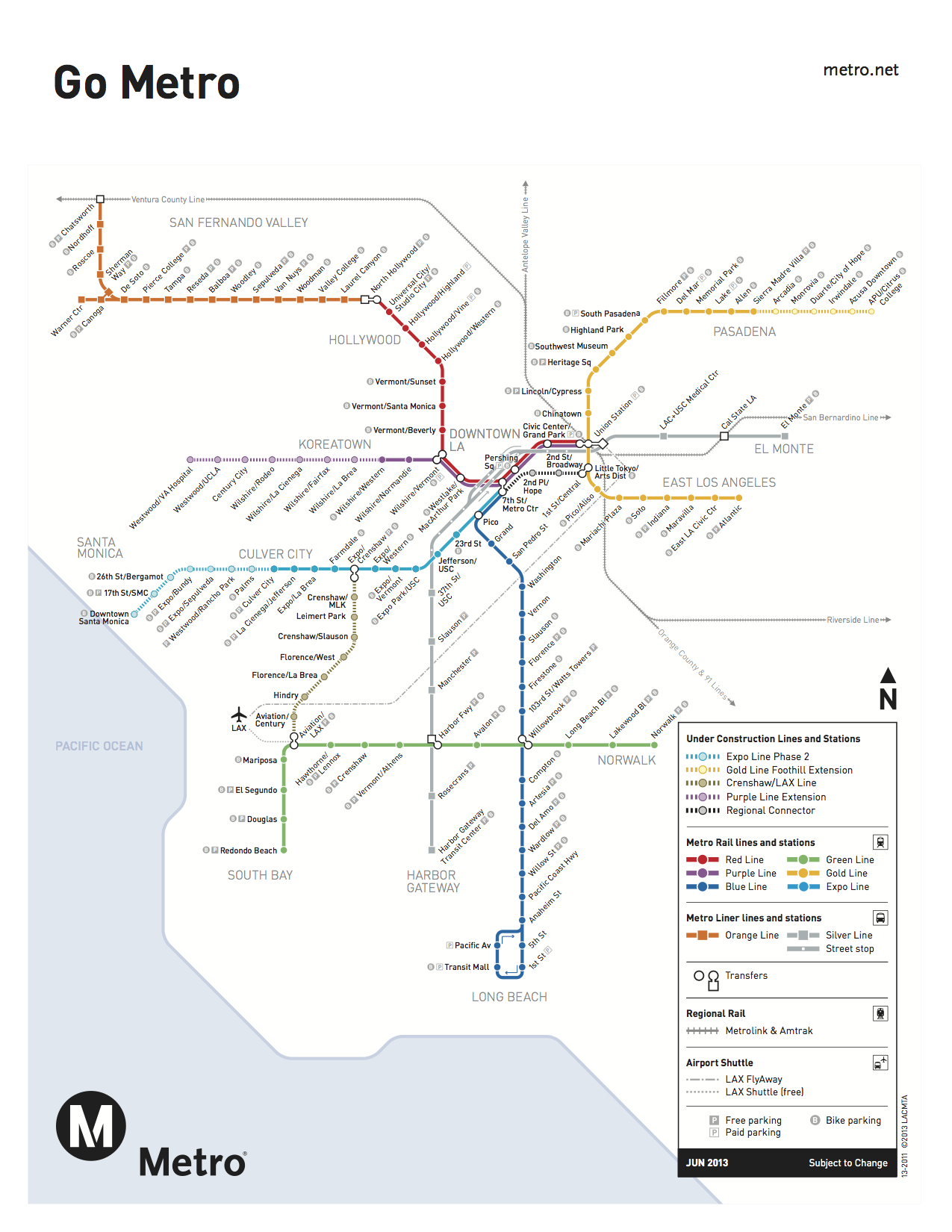
Los Angeles is THE poster child, the ultimate symbol for a new direction, a new future, a new hope.  With two rail transit lines under construction and three about to break ground, the people of SoCal have voted for a future where one can ride a bicycle safely on the streets of Los Angeles for more than one day a year, where you don’t need a car to get everywhere, where walking is a reasonable and safe way to move around the community.

A map of completed and under construction Metro rail lines

Central Avenue and Wilshire Boulevard: Creating a 21st Century Corridor

Central Avenue and Wilshire Boulevard are two urban corridors experiencing similar transitions.  Wilshire recently received designated bus priority lanes.  It (like Central) has more transit riders than any other corridor in the city.  Plans have been approved for rapid transit on the corridor.  However, it will be located underground, providing the city with an opportunity to reshape the streetscape dramatically.

On Central Avenue, an underground transit system makes little sense based the population of our region.  Our options at this point are to do nothing, bus rapid transit (in any variety of shapes or forms), light rail, streetcar or possibly a combination of all of the above.  Each segment of Central has a slightly different need and this needs to be acknowledged.  This community conversation is beginning to bear fruit but it is missing something: a larger regional vision.

The Need for a Regional Vision

Los Angeles is moving forward so rapidly because it developed a regional vision.  In 2008, the people of Southern California voted for a tax increase called Measure R to fund improvements in transportation around the region.  They are not the only metro area which has done this; Tucson also voted on a similar (but much smaller) proposal in 2006 called the Regional Transportation Authority.  All over the country, metropolitan areas are voting not to wait around for the federal government.  They are deciding to work together to develop a vision for the future of the region.  These movements are both bottom up and top down.

Here in Albuquerque, we recently voted to allocate local bond money to be spent on the Paseo del Norte interchange.  This project on its own is not necessarily a bad thing.  However, the fact that it was approved in isolation is a disturbing trend.  Will we continue to just vote on individual projects as needed?  This is a terrible strategy.  The PDN interchange should have been part of a larger transportation improvement package.

A rendering of the proposed improvements to PDN

The advantage of a package is projects which would not necessarily be supported independently can be funded when combined with other more popular projects.  Also, it allows everyone to get a piece of the pie.  For example, the Los Angeles funding measure allocated different percentages of the tax to different pieces of the transportation puzzle: 20% to bus operations, 20% for highway capital projects, etc.

An example from Albuquerque could be 20% for BRT, 10% for Rapid Ride, 5% for protected bike infrastructure, 30% for Paseo del Norte, etc.  The options are limitless and putting it all together results in a strategy and a vision.

ABQ 2020

In order to progress economically as region, we need to develop an infrastructure investment package.  We need to work together to find out which projects are most important, how much they will cost and how they can be a part of developing a 21st century economy.

I will be explaining the specifics of my proposal in a future post.

Thank you for reading and please comment below!